
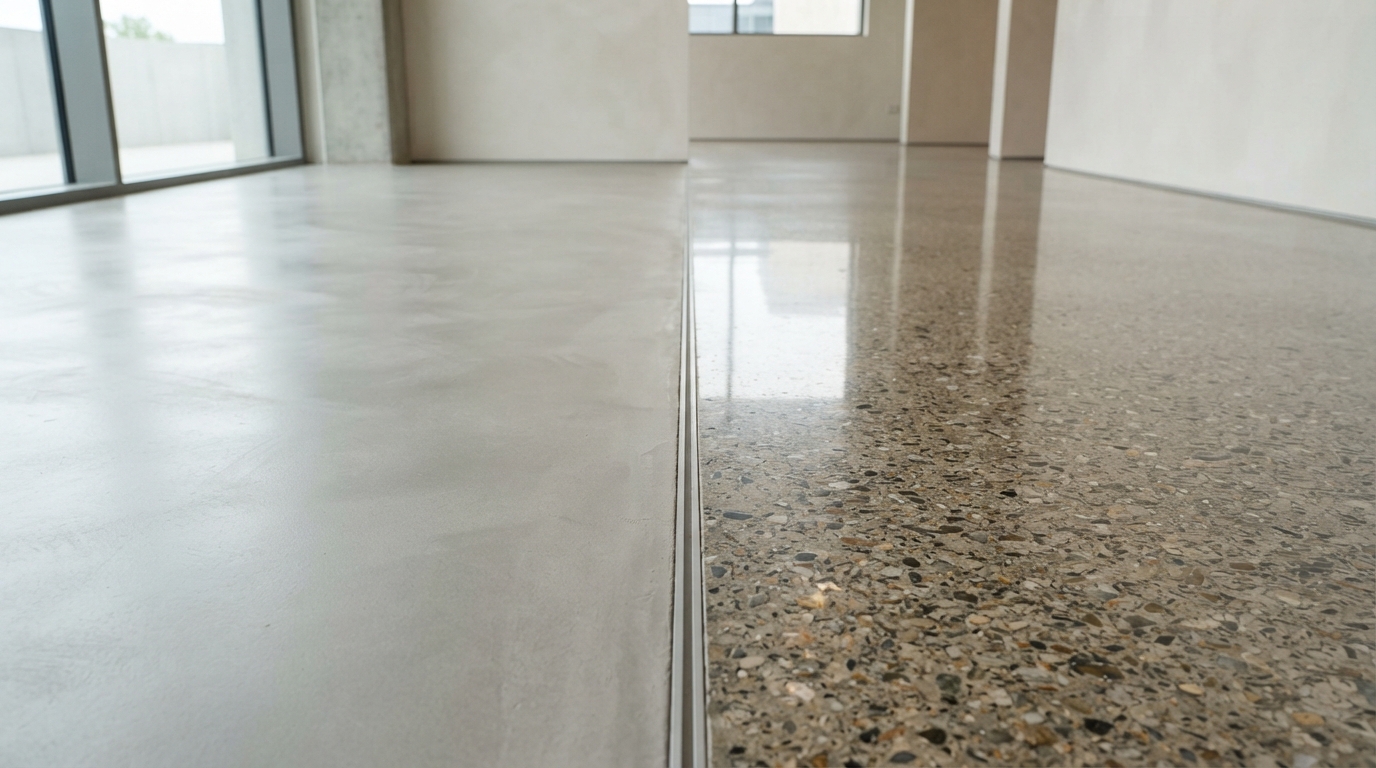
Both micro-topping and polished concrete can create a seamless, modern floor, but they achieve that look in very different ways.
Polished concrete works with the existing concrete slab. The surface is mechanically ground and polished with progressively finer diamond abrasives, allowing the original concrete and, depending on the grind, some of its aggregate to become part of the finished appearance. Micro-topping adds a very thin cement-based overlay over the existing surface, creating a new decorative layer that can be smooth, troweled, colored, or intentionally varied.
So, which looks better in the micro topping vs polished concrete comparison?
If you like natural concrete, visible aggregate, crisp reflections, and an industrial or architectural finish, polished concrete often has the stronger visual appeal. If you want more control over color, movement, texture, and the ability to disguise an unattractive existing surface, micro-topping usually offers more design freedom.
The right choice depends on the look you want and what you are starting with.
Micro-Topping vs Polished Concrete at a Glance
| Feature | Micro-Topping | Polished Concrete |
| Basic appearance | Smooth, troweled, artistic, seamless | Natural, refined, stone-like |
| Uses existing slab visually | Mostly covers it | Showcases it |
| Aggregate exposure | Usually minimal unless specially designed | Can range from little to heavy exposure |
| Sheen | Usually depends on sealer/topcoat | Can range from matte to mirror-like |
| Color control | Very high | Moderate to high |
| Texture options | Extensive | Primarily smooth |
| Hides cosmetic flaws | Better | Limited |
| Natural variation | Created through application | Comes from existing concrete |
| Maintenance | Depends heavily on sealer | Generally straightforward |
| Best aesthetic fit | Custom, minimal, contemporary | Industrial, architectural, upscale modern |
Neither surface is automatically more attractive. They simply produce different visual languages.
What Does Micro-Topping Look Like?
Micro-topping is an ultra-thin decorative concrete overlay.
Some systems can be applied in layers only a fraction of an inch thick. Concrete Network describes micro-toppings and skim coats as ultra-thin overlays that can be applied using trowels, squeegees, brushes, or rollers depending on the desired effect.
Because a fresh cementitious surface is being placed over the slab, the installer has much greater control over what the finished floor looks like.
Common Micro-Topping Looks Include
- Smooth minimalist gray
- Soft clouded movement
- Hand-troweled texture
- Subtle tonal variation
- Warm neutral finishes
- Concrete-look surfaces without exposed aggregate
- Decorative staining
- Layered or mottled effects
This makes micro-topping particularly attractive in interiors where the floor is meant to feel intentionally designed rather than simply refined from an existing slab.
The Installer’s Hand Becomes Part of the Design
A polished floor is largely influenced by what exists inside the concrete.
Micro-topping is different.
Trowel movement, layering, pigmentation, stain application, and finishing technique can all influence the final appearance.
That can create more visual character, but it also means installation quality matters greatly.
What Does Polished Concrete Look Like?
Polished concrete has a more natural relationship with the original slab.
The floor is mechanically ground with diamond abrasives and progressively refined until the desired smoothness and sheen are reached.
The finished look can vary considerably.
Polished concrete does not always mean an extremely glossy gray floor.
Polished Concrete Can Range From
- Matte
- Satin
- Low gloss
- Medium gloss
- High gloss
- Mirror-like reflectivity
The amount of aggregate exposed can also change.
Concrete Network notes that polished floors can be specified with different levels of aggregate exposure and different sheen levels, from subtle satin finishes to highly reflective surfaces.
Aggregate Changes the Character of the Floor
A light grind may expose almost no aggregate.
A deeper grind can reveal:
- Sand
- Small stone
- Larger aggregate
This can make polished concrete resemble natural stone or terrazzo rather than plain gray concrete.
The important difference is that much of this appearance comes from the slab you already have.
Which Finish Gives You More Design Control?
Micro-topping generally wins when design control is the priority.
Because it creates a new surface, you are not as dependent on the original concrete’s:
- Color
- Aggregate distribution
- Patches
- Previous stains
- Surface appearance
Micro-toppings can also accept integral pigments, stains, dyes, and decorative treatments.
Choose Micro-Topping When You Want
- A specific shade
- A softer concrete look
- Consistent visual direction
- Handcrafted movement
- Decorative variation
- Minimal aggregate exposure
- A new visual surface over old concrete
Polished concrete offers customization too, but the existing slab still plays a central role in the outcome.
Which Finish Looks More Natural?
Polished concrete generally has the advantage if by “natural” you mean seeing the actual material.
Grinding reveals what is already inside the concrete.
Small differences in:
- Aggregate
- Patches
- Slab pours
- Color
- Surface history
may remain visible.
For some interiors, that is exactly the appeal.
The floor feels authentic rather than manufactured.
Natural Does Not Mean Uniform
This is important.
If you expect every square foot of polished concrete to look identical, you may be disappointed.
Concrete is naturally variable.
Two areas poured at different times may polish differently.
A repaired section may remain visible.
That irregularity can add character in an industrial or architectural space, but it may be less desirable in a highly controlled minimalist interior.
Which Looks More Refined?
That depends on what “refined” means in the design.
Polished Concrete Can Feel More Refined When You Want
- Gloss
- Reflectivity
- Exposed aggregate
- Crisp architectural lines
- A stone-like surface
Micro-Topping Can Feel More Refined When You Want
- Soft matte surfaces
- Controlled color
- Subtle tonal movement
- Minimal joints and visual noise
- Hand-finished texture
A luxury retail store might choose highly polished concrete for reflectivity.
A contemporary home might prefer a soft gray micro-topping with subtle trowel variation.
Both can look sophisticated.
Existing Slab Condition Can Decide the Winner
A beautiful polished floor requires a suitable slab.
Concrete Network notes that polishing is best suited to structurally sound concrete without major cracks, spalling, or extensive unevenness. When a floor has significant surface problems, resurfacing with an overlay may provide more options for disguising those imperfections.
This can completely change the decision.
Polished Concrete May Be Better When
The existing floor is:
- Structurally sound
- Relatively even
- Visually interesting
- Free from excessive patching
- Suitable for grinding
Micro-Topping May Be Better When
The slab has:
- Unattractive discoloration
- Previous surface repairs
- Cosmetic imperfections
- A finish you want to completely change
A thin overlay can create a new visual canvas.
But Micro-Topping Does Not Fix Structural Problems
An overlay should not be treated as a way to hide serious concrete failure.
Concrete Network notes that overlays depend heavily on the condition of the substrate and can reflect cracking when applied over unstable concrete.
Cracks, movement, moisture, and structural problems need to be evaluated first.
Which One Hides Old Concrete Better?
Micro-topping. That is one of its clearest aesthetic advantages.
A polished concrete floor exposes and refines the existing slab. That means old repairs, stains, aggregate differences, and other variations may remain visible.
Micro-topping adds a new surface over them.
It can therefore be useful when you like the general concrete aesthetic but dislike the current appearance of the floor.
Think of the Difference This Way
Polishing says:
“Make this concrete look its best.”
Micro-topping says:
“Give this concrete a new decorative surface.”
That distinction is often more useful than comparing technical specifications.
Which Finish Offers Better Color Options?
Both can be colored, but micro-topping generally gives you greater control.
Micro-topping systems can often be:
- Integrally colored
- Stained
- Dyed
- Layered in different tones
Concrete Network notes that many micro-topping systems accept integral color and can also receive topical stains or dyes.
Polished concrete can also be colored with dyes or stains, but the original concrete still influences the final appearance.
If Exact Color Direction Matters
Micro-topping may be easier to work into a defined interior palette.
Examples include:
- Warm beige
- Soft taupe
- Off-white
- Charcoal
- Warm gray
If you prefer natural concrete variation, polishing may be more appealing.
What About Texture?
This is another area where micro-topping offers greater flexibility.
Depending on the application method, the surface can be:
- Very smooth
- Lightly textured
- Troweled
- Layered
- More expressive
Decorative overlays can produce finishes ranging from ultra-smooth to noticeably textured.
Polished concrete, by contrast, is primarily about smoothness.
The actual decorative variables are more often:
- Gloss
- Aggregate exposure
- Color
rather than physical surface texture.
Which One Reflects More Light?
Polished concrete generally wins.
High-level polishing can create substantial reflectivity without relying on a topical glossy coating.
At higher polish levels, the floor can clearly reflect lighting and surrounding objects.
That makes polished concrete appealing in:
- Retail stores
- Showrooms
- Large open interiors
- Commercial spaces
- Contemporary homes
A reflective floor can also make a room feel brighter.
Micro-Topping Can Still Have Sheen
A micro-topping can receive a sealer or coating that creates:
- Matte
- Satin
- Gloss
But that sheen comes from the finishing system applied over the overlay rather than from mechanically polishing the original slab itself.
Which Surface Looks Better in a Home?
Micro-topping often works particularly well in homes where a softer, more controlled appearance is desired.
It can complement:
- Minimalist interiors
- Warm modern design
- Contemporary kitchens
- Open-plan living areas
- Bathrooms
- Neutral palettes
The ability to control tone and trowel character makes it easier to coordinate with cabinetry, wall finishes, furniture, and lighting.
Polished Concrete Works Well in Homes Too
It tends to suit interiors that lean toward:
- Industrial
- Loft
- Modern
- Brutalist
- Architectural
A lower-sheen polish can also make the floor feel less commercial.
You do not have to choose a mirror finish.
Which Looks Better in Commercial Spaces?
Polished concrete has become common in commercial settings because its appearance works well across large areas and it offers practical maintenance benefits.
Typical applications include:
- Retail
- Warehouses
- Offices
- Restaurants
- Showrooms
A high polish can create a bright, professional surface while retaining the industrial character of concrete.
Micro-topping may be preferable in boutique environments where the floor itself is part of the brand design.
Examples include:
- Galleries
- Salons
- Hospitality interiors
- Luxury retail
- Creative offices
Maintenance Changes How the Floor Looks Over Time
The best-looking floor on installation day is not necessarily the one that will look best several years later without proper care.
Polished Concrete Maintenance
Polished concrete generally requires:
- Dust mopping
- Regular cleaning
- Neutral-pH cleaners
- Periodic refinement if shine decreases
Polished concrete typically does not require routine waxing or a conventional topical coating when properly finished.
This contributes to its popularity in high-traffic areas.
Micro-Topping Maintenance
A decorative micro-topping normally depends on a protective sealer or coating.
That protective layer can eventually need maintenance or renewal depending on:
- Traffic
- Coating type
- Cleaning
- Exposure
Decorative overlays generally rely more heavily on topical protection than fully polished concrete.
This does not make micro-topping a poor choice. It simply means the finish system matters.
Which Is More Durable?
For heavy traffic, properly polished structural concrete generally has the performance advantage.
The densification and polishing process creates a durable finished surface, and there is no thin decorative layer separating traffic from the structural slab.
Micro-toppings can also perform well, but they remain overlays.
Their performance depends greatly on:
- Product
- Thickness
- Surface preparation
- Bonding
- Sealer
- Substrate stability
This is why installation quality is especially important.
What Happens if the Concrete Cracks?
Neither finish magically prevents structural movement.
With Polished Concrete
A crack is part of the underlying slab and generally remains visible unless repaired.
Some designers intentionally leave repaired cracks visible as part of the concrete character.
With Micro-Topping
A crack underneath can eventually reflect through the overlay if the substrate continues moving.
Concrete Network specifically cautions that overlays placed on actively cracked concrete can crack as well.
Cracks should therefore be evaluated before either finish begins.
Can Micro-Topping Look Like Polished Concrete?
Yes, to a degree.
A smooth gray micro-topping with the appropriate finishing system can create a clean concrete appearance.
There are also polishable overlay systems designed to create a polished look while hiding some imperfections in the original slab.
This can offer a middle ground when:
- Existing slab is visually unattractive.
- You still want a polished appearance.
- Aggregate or color needs more control.
It is technically different from simply polishing the original concrete.
Which Finish Is Better for a Minimalist Interior?
Both can work, but they create different types of minimalism.
Choose Micro-Topping for Softer Minimalism
Think:
- Smooth gray surface
- Subtle trowel movement
- Low sheen
- Warm neutral colors
Choose Polished Concrete for Architectural Minimalism
Think:
- Natural concrete
- Visible aggregate
- Sharp reflections
- Industrial simplicity
Your lighting and furniture can make the same floor feel very different.
Aesthetic Decision Checklist
Ask these questions before choosing.
Choose Micro-Topping If:
- You dislike the existing concrete appearance.
- You want greater color control.
- You prefer subtle hand-applied texture.
- You want minimal aggregate visibility.
- You want to disguise cosmetic surface variation.
- You prefer matte or soft contemporary finishes.
Choose Polished Concrete If:
- Existing slab is suitable for polishing.
- You like natural material variation.
- You want visible aggregate.
- You prefer a smooth finish.
- You want strong reflectivity.
- Low-maintenance performance is a priority.
If you checked several boxes on each side, the final decision may come down to viewing physical samples.
Always Review Samples Before Choosing
Concrete finishes are difficult to judge from small website photos alone.
Lighting changes them considerably.
The same gray floor can look:
- Warm under one lighting system
- Cool under another
- Highly reflective near windows
- Much flatter in low light
Whenever possible, review:
- Physical samples
- Completed installations
- Mockups on the actual slab
For micro-topping, look at the installer’s trowel style and color variation.
For polished concrete, establish the desired aggregate exposure and gloss level before polishing begins.
So, Which Finish Actually Looks Better?
There is no universal winner in the micro topping vs polished concrete comparison.
Micro-topping generally looks better when you want a controlled, decorative surface with greater freedom over color, texture, and visual consistency. It is particularly useful when the existing slab does not have the appearance you want.
Polished concrete often looks better when the original slab is attractive and you want a natural, architectural finish with visible concrete character, adjustable aggregate exposure, and anything from a subtle satin surface to a highly reflective polish.
For the strongest result, the floor condition and design goal should be evaluated together. We at PEC Floors install and finish decorative concrete flooring for spaces that need anything from a subtle, seamless micro-topping to a refined polished-concrete appearance. The right system starts with assessing the existing slab, the traffic it will receive, and the visual character you want the finished room to have.
